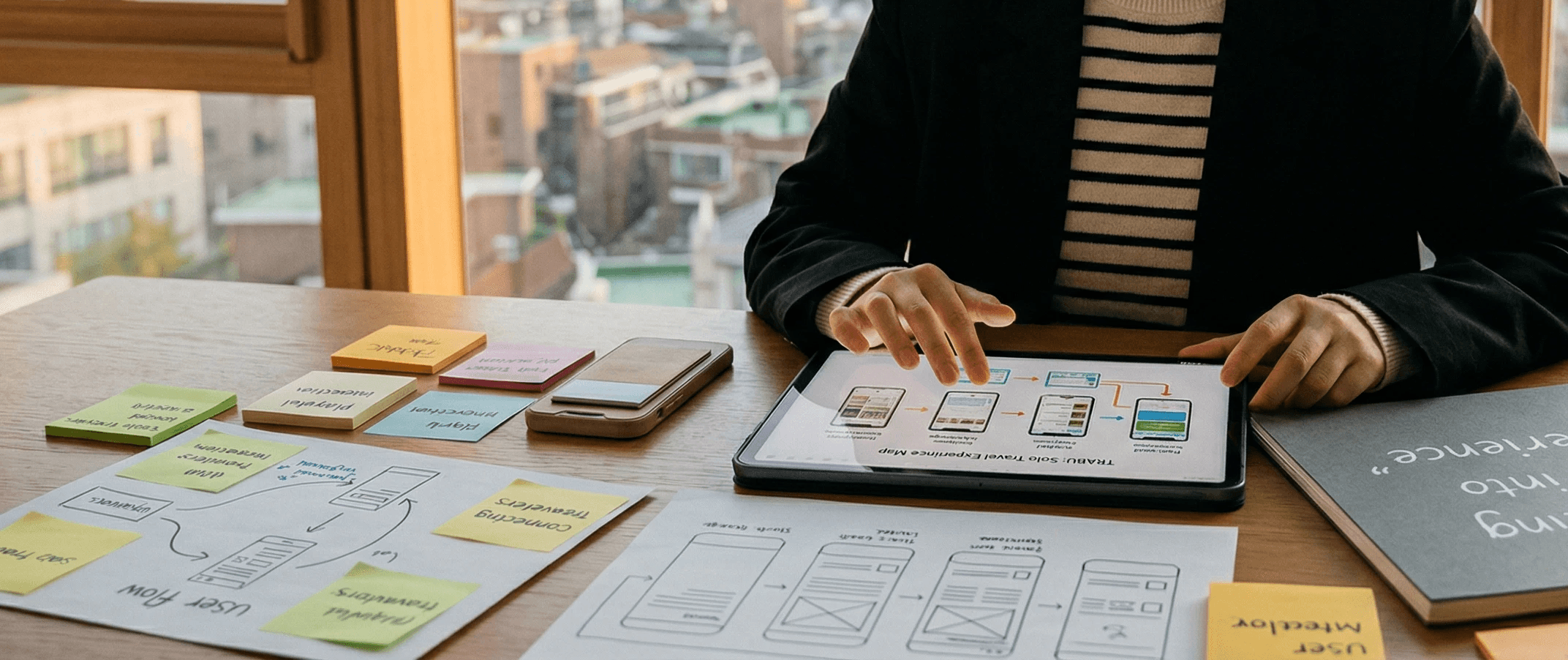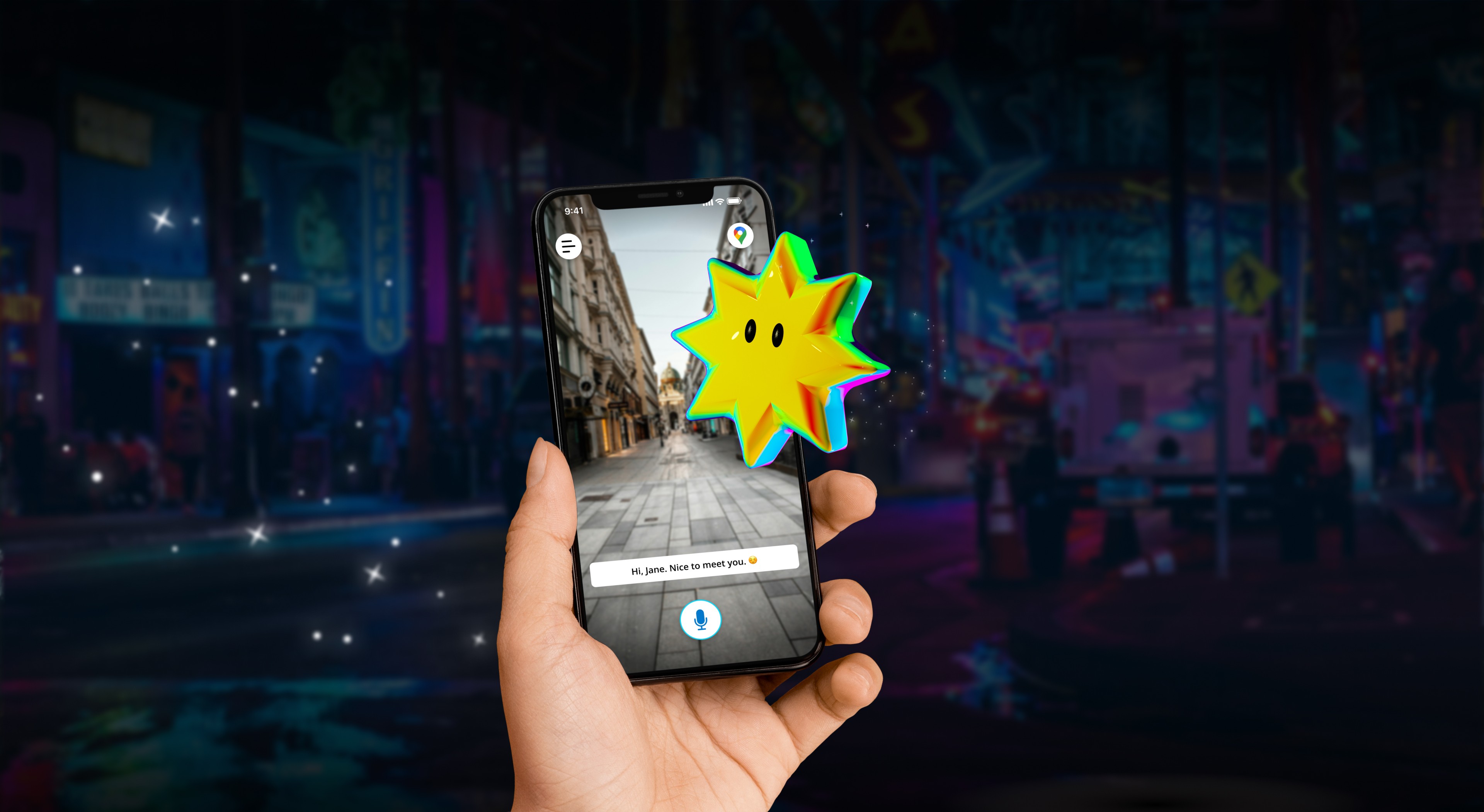

Creative AR & AI Travel Buddy App
TRA-BU is an AR/AI travel buddy concept that reframes trip planning as a calm, low-friction journey—from broad exploration to a single next action—reducing information overload, travel anxiety, and decision fatigue. The experience prioritizes a dependable, accessible baseline that protects privacy and delivers immediately actionable guidance in real travel contexts.
My role focused on designing a reliable touch-first interaction system that preserves the “assistive companion” feel without forcing users to think like the system. I translated interview insights into a structured UX flow, built a cohesive UI system and AI character interactions, and iterated through prototyping and two usability tests to tighten UX writing, restructure recommendation logic, and add clear first-time guidance—minimizing cognitive load.
MY ROLE
AR Interaction & Spatial UI Designer
Skills
Spatial UI Design (AR),
Immersive Interaction Design,
Visual Language Development,
3D Asset Planning & Prototyping,
Narrative-Driven Design
Team
Personal Project
Timeline
January 2024 - May 2024
01 | overview
Key highlights
TRA-BU reframes trip solo travel planning as a calm, companion-like journey rather than a stressful decision-making task. Through a gamified AI guide, playful interactions, and accessible real-time support, the project reduces information overload and travel anxiety—making travel feel more manageable, personal, and reassuring.

YOU ARE NOT ALONE
Human Like Travel Support
Travel can feel lonely and confusing, especially when plans change. Trabu acts as a friendly AI travel buddy that listens, responds in real time, and helps users feel supported wherever they go.
TURN ROUTES INTO MOMENTS
Playful Guidance
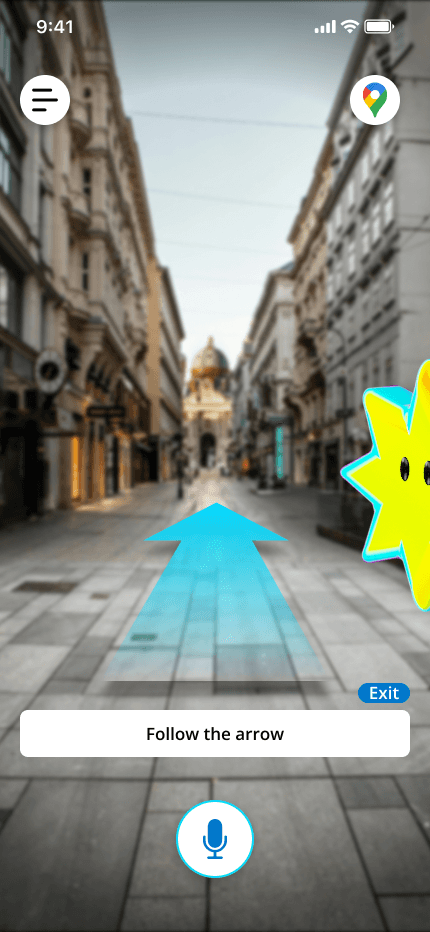
Navigation does not have to be boring. By combining AR navigation with small games and characters, Trabu turns getting lost into a playful experience that keeps users curious and engaged.

NO DISTANCE REQUIRED
Travel For Everyone
Travel should not be limited by time, money, or physical conditions. Trabu lowers barriers by offering accessible, personalized travel experiences that anyone can enjoy in their own way.
02 | concept
background
Navigating an unfamiliar place can quickly become confusing and tiring. Solo travelers often need more than information—they need guidance that feels immediate, clear, and reassuring.

Most travel tools are designed to inform, not accompany. This raised a question:
💭 What if travel guidance felt less like using a tool, and more like being accompanied by a dependable virtual buddy?
Competitive Analysis Highlights
Existing platforms tend to focus either on gamification alone or on chatbot systems that merely respond to user questions.

Playful, but not built for travel support.


Useful for travel questions,
but not playful or immersive.

Insight
The strongest opportunity was to combine the engagement of gamified experiences with the utility of real-time travel support.
User interview
To better understand solo travelers’ needs, I interviewed users about when they feel tired during travel and how they use chatbot AI today.
Many wanted a travel buddy for long or lonely trips, but also described why existing chatbot tools often fall short.

Overseas Traveler Yeonoh Eo | 20 | University Student (Biology Major)
"When traveling, I stay more focused and understand places faster with an instant, interactive guide than with a detailed planner."
Problem
Some solo travelers need real-time guidance, not detailed planning tools.
Insight
For some solo travelers, effective support comes not from detailed planning, but from lightweight, real-time guidance.

Domestic Traveler Jeagyu Jang | 23 | University Student (CS Major)
"Actually, I am skeptical about AR chatbot apps because they are hard to understand and use right away."
Problem
AR chatbot apps can feel hard to understand and use at first.
Insight
For first-time users, real-time support only works when the interaction feels clear from the start.

Student Studying Abroad Seoyeon Park | 18 | University Student (CS Major)
"I do not often feel the need to use chatbots in situations where safety matters, such as traveling, because for now, Googling feels more trustworthy to me."
Problem
In safety-sensitive travel moments, AI answers can feel risky when users cannot verify them quickly.
Insight
Clear interaction builds first-use comfort, but travel trust depends on whether guidance can be quickly confirmed.
research summary
For some solo travelers, effective support comes not from more information, but from real-time, low-burden guidance that feels easy to follow and trust.
By benchmarking existing platforms and listening to users’ travel experiences, I uncovered key gaps in how travel support is currently delivered and experienced. These insights were translated into clear goals: creating a travel experience that feels less like searching for answers and more like being guided in real time.
Pain point
Confusing first-time AR interaction
Feeling a lack of companionship
Lack of playful engagement in travel support
Opportunity
Familiar and intuitive onboarding
A warmer, more supportive tone
03 | development
Shaping the Build
overall project direction
I aimed to build an AR and AI travel buddy app that keeps users engaged through gameplay while providing useful travel guidance and a sense of companionship. After ideation, I made the concept tangible by sketching core interactions and characters, building early 3D assets in Blender, and iterating through solo testing and screen-based prototyping to refine scale and interaction distance.
Persona & Scenario
Define Users
Identify goals and context
User Flow & Wireframe
Structure Flow
Turn insights into steps
Usability Testing
Validate & Refine
Test, learn, and iterate
ideation sketch
I developed the interface based on my experience of getting lost while traveling alone, using AR arrows and voice guidance to support more intuitive wayfinding.
I designed the character to feel both like a travel companion and a collectible figure, using floating, bird- and fairy-like forms to create a playful and approachable presence.


Persona & Scenario Map
Based on the research insights, I developed personas and a scenario to illustrate key moments in the travel journey—especially where travelers may feel uncertain, need support, or look for a more engaging experience.

Assaf Miller
23 • Introverted Traveler & International Student
Assaf hears from a friend that solo travel is a lot of fun and decides to go on a trip by himself. However, he is anxious about traveling alone.
Scenario 1
Assaf plans a spring break trip to the U.S. He asks TRABU for the cheapest flights and New York hotels, gets a recommended option with a link, and books it right away.
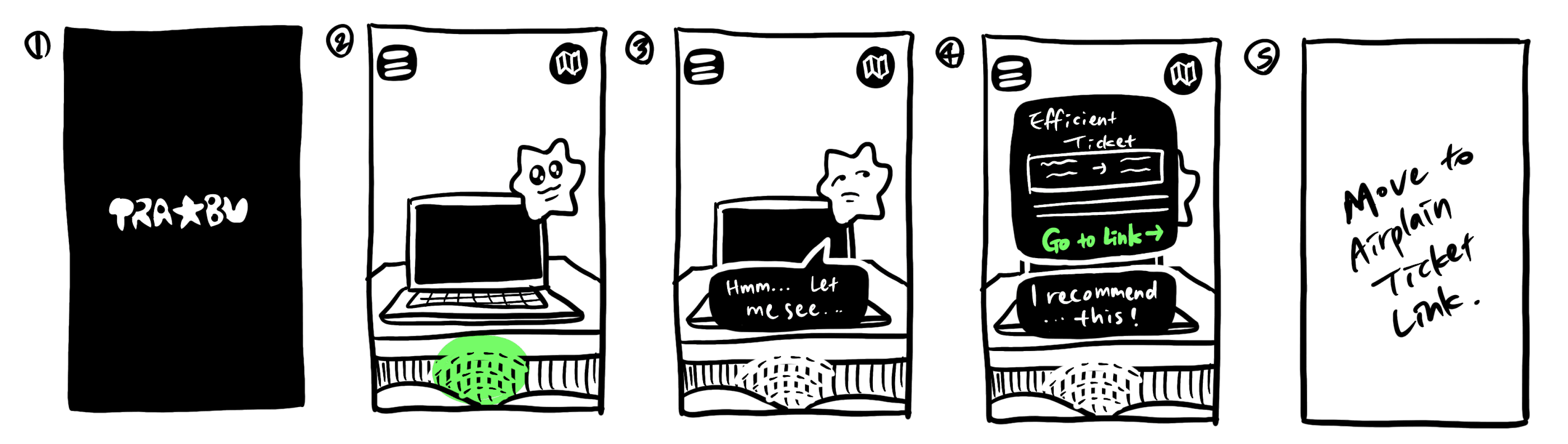
Book the Ticket
Scenario 2
Assaf asks the character where the plane gate is. The character asked when and where his flight was departing. When he answered, he found the gate and marked it with an arrow on the screen.

Scenario 3
While walking alone, Assaf finds a new character in TRABU, captures it, and switches it as his main character.
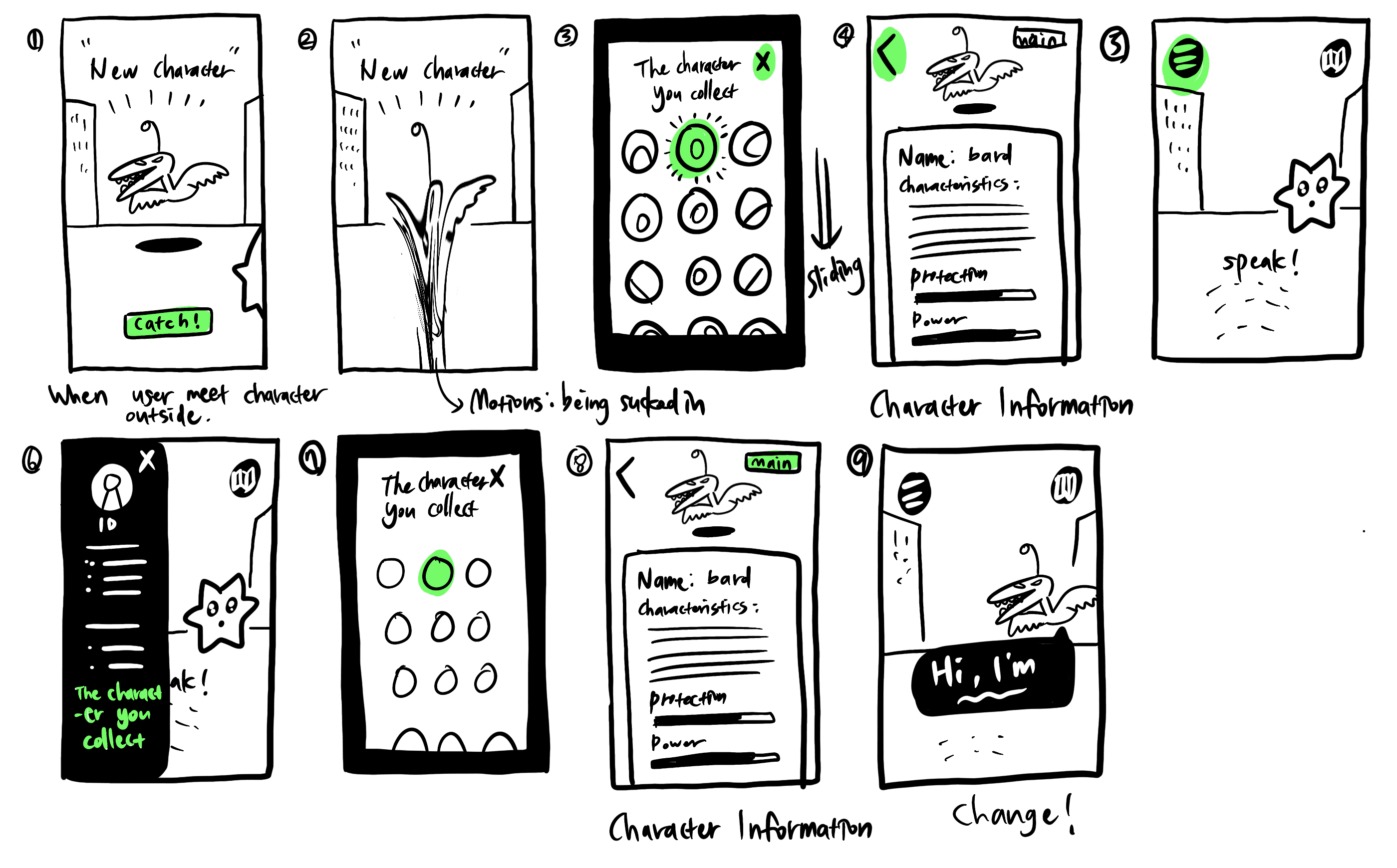
User flow
After that, I defined TRABU’s solution and refined the user interaction logic through repeated feasibility checks with an expert.

Wireframe
Based on these findings, I translated the user flow into wireframes to clarify key paths and strengthen the overall logic before moving into visual design.

Usability testing
To evaluate TRABU’s usability, I conducted two rounds of moderated usability testing using the same core tasks. The first round identified usability issues in a low-fidelity prototype, and the second evaluated a refined high-fidelity version updated from the initial feedback. This process helped confirm whether the revised UI improved clarity and usability.
1st Usability Testing
The first test showed that the concept felt creative and fun, while highlighting issues in the initial character setup and location-based privacy, which guided later design changes.
Test Target
3 participants (university students, 20–25), 10 - 15 min each
Test Result
Worked Well
The idea felt creative and fun
Pain Points
The initial character setup flow felt unnatural
Privacy concerns emerged around location-based services
Design Changes After Testing
Simplified the character setup flow
Added a clearer privacy consent step during sign-up

2st Usability Testing
The second test showed that most tasks were completed smoothly, while highlighting issues with the profile photo button and map icon, which led to additional UI refinements.
Test Target
Same participants as 1st UT, 15 min each
Test Result
Worked Well
Most tasks were completed smoothly
Pain Points
The top-left profile photo button felt too similar to dating app UI
The map icon was not intuitive enough at first glance
Design Changes After Testing
Removed the profile photo button
Redesigned the map icon to better communicate navigation

Easy
Moderate
Hard
First, the easy tasks focused on evaluating the basic sign-up process after launching the app. The goal was to confirm whether users could complete fundamental actions without difficulty.

Task 1
Open App
Task 2
Click the Sign Up Btn
Task 3
Fill in All the Blanks (about Your Personal Information)
Task 4
Read, Check the Terms of Service, and Finish Sign Up

Task 5
Swipe and Take a look at the characters
Task 6
Check the Character's information
Task 7
Choose the Character
The usability sessions showed that the main issue was not usability in a functional sense, but ambiguity in role perception. Users were more willing to engage when TRABU immediately felt like a supportive travel companion, but hesitation grew when early interface cues made its character, guidance, or data use feel unclear.
Insight
User trust in TRABU was shaped before its main value could be experienced. Participants were open to the idea of an AI travel companion, but weak early cues left them unsure how to interpret the character’s guidance, presence, and access to personal information.
04 | outcome
solution
During the solution stage, I focused on helping first-time users understand TRABU more quickly, access relevant travel information, and maintain an enjoyable experience throughout the journey.
" AR Travel Companion Experience "

Playful Travel Experience
Made solo travel feel more playful and immersive

Voice Interaction Flow
Made it easier to ask questions and follow spoken responses

Information Handoff
Smoothed the transition from spoken suggestions to external details
From Framework to Experience
The final prototype of Trabu integrates AR navigation, voice-based guidance, and playful character interaction into a single, cohesive travel flow. Interactions are intentionally structured to guide users from initial orientation to local discovery and deeper engagement, helping solo travelers navigate unfamiliar places with greater ease and confidence. Rather than focusing solely on efficient wayfinding, the experience encourages users to enjoy the journey itself through trust, curiosity, and playful exploration.
Start
Personalized Setup
Designed to tailor the experience to each traveler from the very beginning, this step lets users set their travel style, preferences, and desired level of companion support. The onboarding flow establishes a more personal and trustworthy relationship with Trabu, helping the AI buddy feel less like a tool and more like a travel companion from the start.
The prototype video may take some time to load. Please wait a moment.
Connect
Playful Character Chat
This interaction was designed to make the first encounter feel light, friendly, and emotionally engaging rather than purely functional. Through casual conversation with the AR character, users can ease into the experience, build familiarity, and feel accompanied during solo travel, setting the tone for a more playful and approachable journey.
The prototype video may take some time to load. Please wait a moment.

Explore
Information Search & AR Navigation
Built to support travelers in unfamiliar environments, this flow allows users to ask questions naturally and receive location-based recommendations alongside AR guidance. By combining voice-based interaction with visual navigation, the experience helps users move through places more confidently while keeping the process intuitive and immersive.
The prototype video may take some time to load. Please wait a moment.
Play
Character Collection Game
Designed to shift the experience beyond utility, this feature turns travel moments into playful opportunities for discovery and reward. By collecting characters throughout the journey, users are encouraged to stay curious, explore more actively, and enjoy the travel process itself rather than focusing only on reaching the destination.
The prototype video may take some time to load. Please wait a moment.
Watch Full Prototyping Video
design system
To bring greater structure to the interface, I established a design system that defined Trabu’s color system, typography, and core UI elements. This helped create a more consistent visual language and supported a clearer, more recognizable experience for solo travelers.
Openness
Trust
Curiosity
Playfulness
Immersion
Color System
Font System
Bold
34, 17px
ABCDEFGHIJKLMNOPQRSTUVWXYZ
abcdefghijklmnopqrstuvwxyz
1234567890’~-!?*
Regular
17px
ABCDEFGHIJKLMNOPQRSTUVWXYZ
abcdefghijklmnopqrstuvwxyz
1234567890’~-!?*
SemiBold
17, 13px
ABCDEFGHIJKLMNOPQRSTUVWXYZ
abcdefghijklmnopqrstuvwxyz
1234567890’~-!?*
OpenSans
UI Elements

05 | Validation
what i learned
"Translating Vision into Experience"
Through Trabu, I learned that the value of a concept lies not in how compelling it sounds, but in how clearly it can be translated into experience. What began as an open-ended idea around solo travel, companionship, and play gradually became more defined through prototyping, where assumptions had to take the form of actual user flows and interactions. This process taught me how validation is not separate from design thinking, but a critical step in giving vague ideas structure, clarity, and direction.